Recruitment agencies rely on technology to operate at speed. From sourcing and screening to interviews, references, submissions, and reporting, software sits at the centre of the modern recruitment desk.
Yet despite this reliance, recruitment remains one of the most expensive industries to operate from a technology perspective.
This is not widely discussed, and many agencies only realise the scale of the issue when margins start to feel tight. The reality is that recruitment technology has evolved in a way that quietly drives costs, often without improving outcomes.
This article explores what recruitment agencies are spending on tech, how that compares to other industries, and why many firms are paying what can best be described as a “recruitment tax.”
The ‘hidden admin tax’ isn’t one obvious problem. Your recruitment consultants could be losing valuable hours on things like
- Updating your ATS, and then updating a spreadsheet
- Checking internally who owns a role
- Searching inboxes for feedback
- Manually compiling a client update
- Reconfirming candidate availability
In isolation, none of these feels like too much hassle. But when you add all those tasks up – they start to compete with hours that could be spent on revenue generating work.
If you’re a 5 -10 person team, and each consultant in your agency loses 6 – 8 hours a week carrying out unnecessary admin and duplicating work – that can equal one consultant’s total output. Without hiring another one. (could put this into a callout box/visual tile or quote style formatting)
Where time disappears in most ATS setups for small agencies
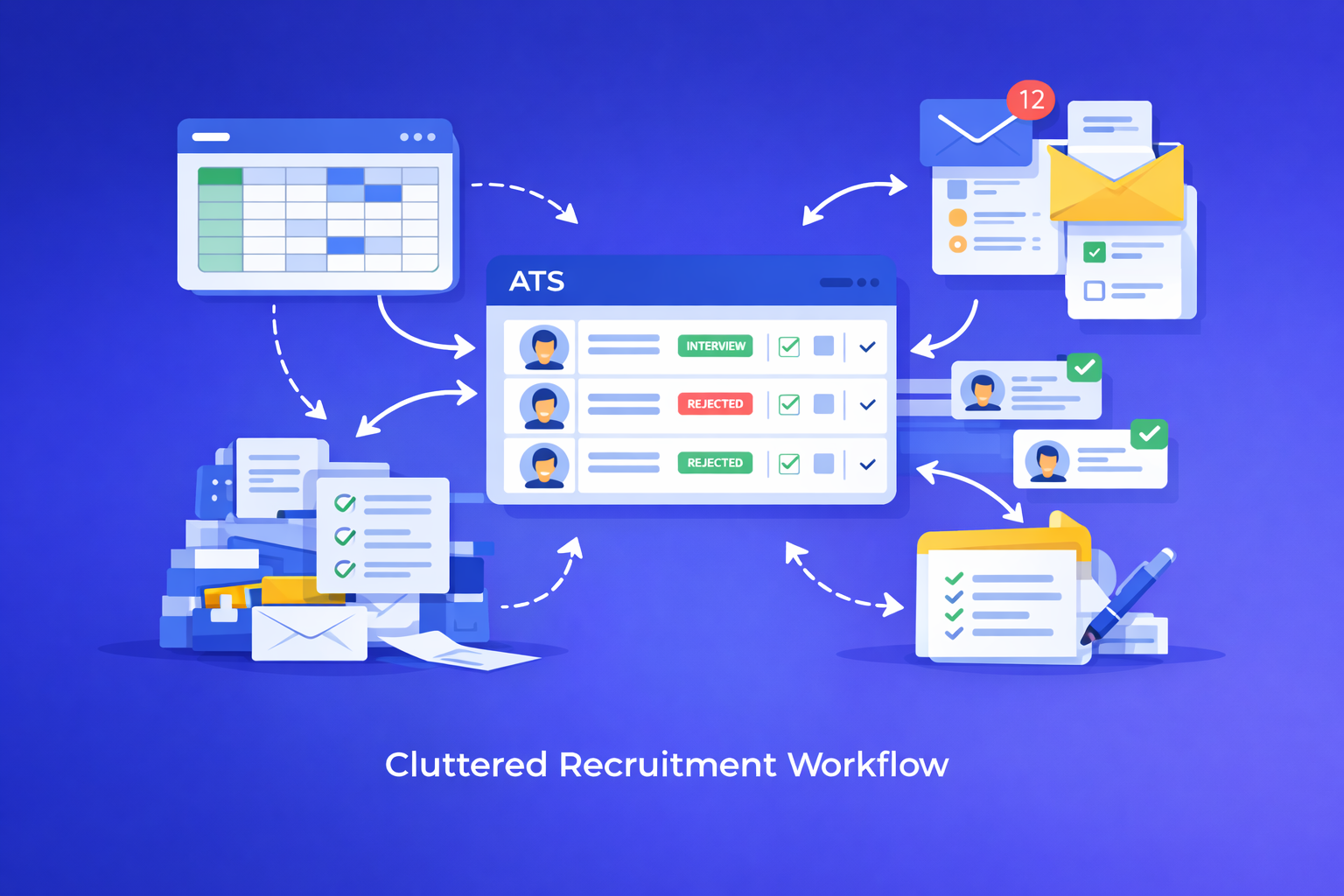
When we speak to small agency owners, the patterns tend to be similar. We hear that often Applicant Tracking Systems and Recruitment CRMs don’t quite meet requirements, so consultants end up building their own workarounds. That’s things like:
- Personal spreadsheets
- Separate tracking sheets
- Email folders
- Notes outside the core system
Teams are asking questions like has this candidate already been submitted? Is this role still live? Who’s speaking to this client? Those small internal clarifications can slow things down, and take up valuable time.
Email chasing and internal status checks
In smaller agencies, emails often become the unofficial source of truth.
Feedback sits in threads and availability updates come through email.
If your recruitment CRM doesn’t give your agency a clear view, consultants may be wasting time checking for updates instead of progressing roles.
Duplicate data entry across multiple tools
Many small agencies use multiple systems, all of which require updates.
- An Applicant Tracking System
- A separate recruitment CRM
- Reporting spreadsheets
- Job board portals
- Third-party sourcing tools
When a candidate’s availability changes, does it need to be updated in more than one place? When a role closes, does someone need to update multiple systems?
Duplicate data entry is one of the most common hidden costs in small recruitment businesses.
The commercial impact most agencies don’t calculate
Small agencies usually measure placements, revenue and conversion rates. It’s much harder to measure capacity. But if each of your consultants loses 6 – 8 hours a week to admin that could be reduced, that’s not just inefficient. It means delayed follow ups, less proactive outreach, and generally reduced pipeline activity.
It might seem that the solution is hiring another recruiter. But actually, results can be seen when you make your workflow more efficient.
As well as inefficiency and lost hours, all of the above issues affect client confidence and candidate experience. Not to mention consultant frustration. If your recruitment software is hard to use or unclear, frustration builds and lowers team morale. So reducing admin isn’t just about efficiency. It also protects culture and momentum.
Why many ATS platforms don’t reduce admin for small agencies
If you’ve already invested in recruitment software, you might ask why admin is still a problem. The answer is simple: many systems weren’t built for small agencies. They often prioritise structure and compliance over usability.
Enterprise-focused ATS platforms often:
- Require detailed setup
- Introduce rigid workflows
- Prioritise structure over speed
Especially for agencies with 1- 20 staff, rather than simplifying workflow management, enterprise systems can feel like another layer to manage.
Feature-heavy and AI-led tools can increase complexity
Newer recruitment platforms often lead with automation and AI functionality. Automation can remove repetitive tasks. But if the system becomes dependent on automation, you may experience:
- Less transparency
- Ongoing usage-based pricing increases
- Reduced control over workflow
You need recruitment automation tools that support your team, not reshape your business model (we’lll explore this balance in more detail in our upcoming blog on responsible AI in recruitment.)
A simple way to measure your hidden admin tax
Ask your team how many hours per week they spend on:
- Updating multiple systems
- Compiling reports
- Checking status internally
- Re-entering information
Multiply that by your team size.
The number is usually higher than expected. And it often explains why the team feels stretched, even when headcount seems right.
Recruitment software for small agencies should create capacity
Small recruitment agencies don’t need more dashboards. You need:
- Clear visibility over live candidate availability and status
- Shared ownership
- Reduced duplication
- Simple, practical ATS functionality
When admin reduces, placements increase naturally. Not because your team works harder. Because they finally have time.
The hidden admin tax is easy to ignore, but hard to afford
Admin doesn’t show up as a separate expense. It shows up as lost capacity.
If your agency feels constantly busy but growth feels harder than it should, your systems may be part of the constraint.
Want to understand what this might be costing your agency? Download our hidden admin tax calculator checklist…