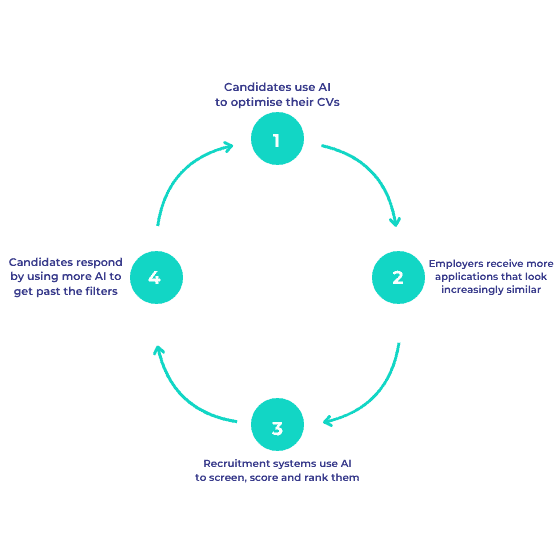
WIRED recently described this as an “AI doom loop”, with candidates and employers increasingly using technology to overcome problems created by the technology being used on the other side.
At the same time, AI adoption across recruitment is accelerating. LinkedIn found that 37% of recruiting organisations were actively integrating or experimenting with generative AI in 2025, up from 27% the year before.
And the CV itself is changing too.
ABC News reported that growing numbers of candidates are using AI to tighten language, tailor applications and present their experience more effectively. As a result, recruiters are seeing more polished applications, but also more CVs that look and sound increasingly similar.
So this isn’t nessecarily saying AI is the problem but what we’re asking it to do right now.

TIME TO RETHINK THE RANKING
A CV is only the beginning
Most recruitment systems still place enormous emphasis on the information contained in an application.
Job title. Keywords. Skills. Experience. Location.
AI can make searching that information considerably quicker.
- It can summarise a CV.
- Compare it against a job description.
- Generate a match score.
- Rank a database.
But recruitment doesn’t stop once you’ve found someone whose CV matches a role.
Actually, that’s where the useful information starts appearing…
- You speak to them.
- You discover what they’re really looking for.
- Their salary expectations have changed.
- You learn they’re available immediately.
- They explain which parts of their previous role they actually enjoyed.
- You find out that a skill listed prominently on their CV hasn’t been used for three years.
An interview reveals strengths that weren’t obvious from the application.
You speak to five candidates and suddenly realise that the person who looked strongest on paper isn’t necessarily the strongest person in the process.
Yet in many ATS platforms, the original CV remains the centre of gravity; the recruiter keeps learning. The system doesn’t.

JOBTETRIS IS DESIGNED TO KEEP LEARNING
Closing the recruitment AI loop
Rather than treating candidate matching as something that happens once at the point of application, JobTetris can keep updating relevance as new information emerges.
Interview notes, availability, salary discussions, changing preferences and recruiter feedback can all alter who is genuinely the best fit. The same is true once a shortlist starts to take shape, because candidates are no longer being judged only against the job description, but against the other realistic options in the process.
Someone who looked strongest on paper may become less suitable once salary or skill recency is discussed, while another candidate may become more relevant after interview.
JobTetris can reflect those changes, helping recruiters move from asking “who matched best at the start?” to “who is the strongest candidate based on what we know now?”
That is what closing the AI loop looks like.

HOW CAN WE VIEW THE BIGGER PICTURE
Recruitment isn’t an absolute score.
Candidate matching is often presented as if it can be reduced to a single percentage: a 92% match, an 84% match, a 76% match. But recruiters operate in context rather than percentages. Once you’ve shortlisted three people, the relevant comparison isn’t necessarily each candidate against thousands of records in the database, it’s increasingly a comparison between those three people themselves.
One has stronger technical experience, another interviewed better. One is immediately available, another has worked in almost exactly the same environment, while one wants $20,000 more than the client’s budget. Those things change the decision, so the technology should be able to change its view too.
JobTetris allows the information gathered during recruitment to influence candidate relevance, rather than continually returning to the same static application data.

FINDING A SYSTEM THAT DELIVERS
Adding AI to an ATS is not the same as transforming recruitment
AI can already write adverts, summarise CVs and speed up admin, but the bigger opportunity is helping recruiters make better decisions as the process develops.
SHRM found that while 51% of organisations were already using AI to support recruitment, only 24% said it had improved their ability to identify top candidates.
This is such an important gap as a candidate who looks strong on paper may become less relevant once salary, availability or recent experience are discussed, while someone who initially ranked lower may become the better option after interview. Proper use of AI, such as within JobTetris can use that new information to keep candidate relevance up to date, rather than relying too heavily on the original CV.