
Choosing the wrong ATS doesn’t just cost you a subscription you’re locked into for a year. It costs you the placements you didn’t make while your team fought a system that doesn’t match how you actually work, and the candidates who walked because the client-facing side of the process looked and felt out of date.
AI has made this decision harder, not easier. SHRM’s 2025 Talent Trends report puts AI adoption in recruitment at 51% of organisations now, and that number keeps climbing (SHRM). Every ATS on the market claims to be “AI powered” somewhere on its homepage. Fewer of them have actually built AI into the core workflow rather than bolting it on as a paid extra, and that difference matters a lot more than the marketing copy lets on.
We put together this comparison to make that difference easier to see. Below is a straight look at ten of the systems recruitment agencies choose between most often, what each one is actually built for, where it holds up and where it doesn’t.
What to look for in an ATS
Core ATS and CRM functionality
The basics still matter most: a pipeline you can actually see at a glance, candidate profiles that hold everything in one place and a CRM that tracks your client relationships alongside your candidate ones. If this part feels clunky in a demo, nothing else on the feature list will fix it.
AI capability, built in or bolted on
Ask whether AI features like note-taking, resume formatting and candidate screening are included in the base price or sold as an add-on. The add-on model usually means a worse version of the feature anyway, since it wasn’t designed as part of the core product.
Candidate and client engagement
Portals are not the same as live engagement. Check whether candidates and clients get real-time chat, interview scheduling and visibility into where things stand, or whether they’re stuck logging into a separate portal to find out anything at all.
Integrations and reporting
Most systems in this list score reasonably well here. The real question is whether the reporting actually tells you something useful about time to fill, pipeline health and revenue forecasting, not just whether a report exists.
Contract terms and support
Lock-in contracts and online-only support show up again and again in this market. If you’re a smaller agency, a month-to-month term with a human on the other end of support matters more than a feature you’ll use twice a year.
Ease of adoption
A powerful system your team won’t actually use is worse than a simpler one they will. Weight this heavily if you’re migrating from a spreadsheet or a much older platform.
| Feature |  JobTetris |
 JobAdder |
 Loxo |
 Atlas |
 Vincere |
 Zoho Recruit |
 Bullhorn |
 Spott |
 Tracker |
 Seven20 |
|---|---|---|---|---|---|---|---|---|---|---|
| Starting price | From $170/user | $190–$250 | Premium tier | ~$250/user | $50–$500/mo | US$115 | Premium tier | $199/user (annual) | $175 + add-ons | Not published |
| Contract term | Month-to-month | Lock-in | Lock-in | Lock-in | Lock-in | Lock-in | Lock-in | Not published | Month-to-month (Starter) | Not published |
| Support | Human | Online | Human | AI-led | Limited | Online | Online | Guided onboarding | Tiered | Not published |
| AI capability built in | ✓ | – | ✓ | ✓ | – | – | – | ✓ | – | ✓ |
| Customisable workflows | ✓ | – | – | – | ✕ | – | ✓ | – | ✓ | ✓ |
| Email integration | ✓ | ✓ | ✓ | ✓ | ✓ | ✓ | ✓ | ✓ | ✓ | – |
| Calendar integration & team visibility | ✓ | ✕ | ✕ | ✕ | ✕ | ✕ | ✓ | – | – | – |
| Native digital references | ✓ | ✕ | ✕ | ✕ | ✕ | ✕ | ✕ | ? | ? | ? |
| Booking links | ✓ | ✕ | – | – | ✕ | ✕ | ✕ | ? | ? | ? |
| Client-facing interview scheduler | ✓ | ✕ | ✕ | ✕ | ✕ | ✕ | ✕ | ? | ? | ? |
| Native AI note taking | ✓ | – | ✓ | ✓ | – | – | – | ✓ | ? | ✓ |
| Resume / CV formatting | ✓ | – | ✕ | ✕ | – | – | – | ✓ | ✕ | ? |
| In-app candidate engagement | ✓ | – | ✕ | ✕ | – | ✕ | – | – | – | ✓ |
| Live candidate availability | ✓ | ✕ | ✕ | ✕ | ✕ | ✕ | ✕ | ? | ✕ | ? |
| Client engagement tools | ✓ | – | ✕ | ✕ | – | ✕ | ✕ | – | ✓ | ✓ |
| Reporting & analytics | ✓ | ✓ | ✓ | ✓ | – | – | ✓ | ✓ | ✓ | – |
| Ease of adoption | Easy | Complex | Medium | Medium | Complex | Medium | Complex | Medium | Medium | Complex |
| Integrations | Strong | Strong | Strong | Limited | Strong | Strong | Strong | Strong | Strong | Strong |
✓Built in and included –Limited, add-on, or not confirmed in public materials ✕Not offered ?Not yet confirmed, flagged for follow-up

FULL REVIEW OF WHAT’S ON THE MARKET
JobAdder
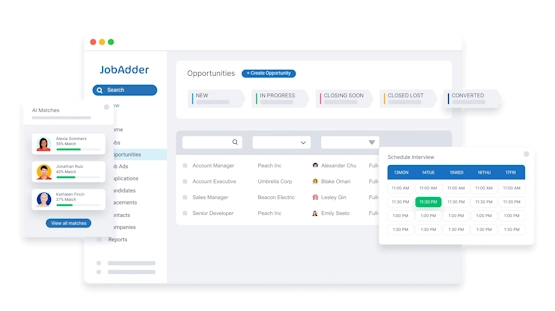
JobAdder is one of the more established names in this list, a traditional ATS and CRM system with a strong reputation for reporting, analytics and integrations.
Features
- Strong third-party integrations across the recruitment tech stack
- Solid reporting and analytics
- Native email integration
Is JobAdder the right ATS for your agency?
It suits agencies that already have their engagement and AI tooling sorted elsewhere and mainly want a dependable ATS and CRM core with good reporting underneath it.
Pros
- Mature product with strong integrations
- Dependable reporting and analytics
- Well known in the market, so easier to hire people who already know it
Cons
- AI capability and workflow customisation are limited compared to AI-native competitors
- AI note-taking and resume formatting are sold as paid add-ons rather than included
- No native calendar integration, team visibility or live candidate availability updates, and candidate or client engagement happens through a portal
- Lock-in contracts, with pricing in the $190 to $250 per user range
Loxo
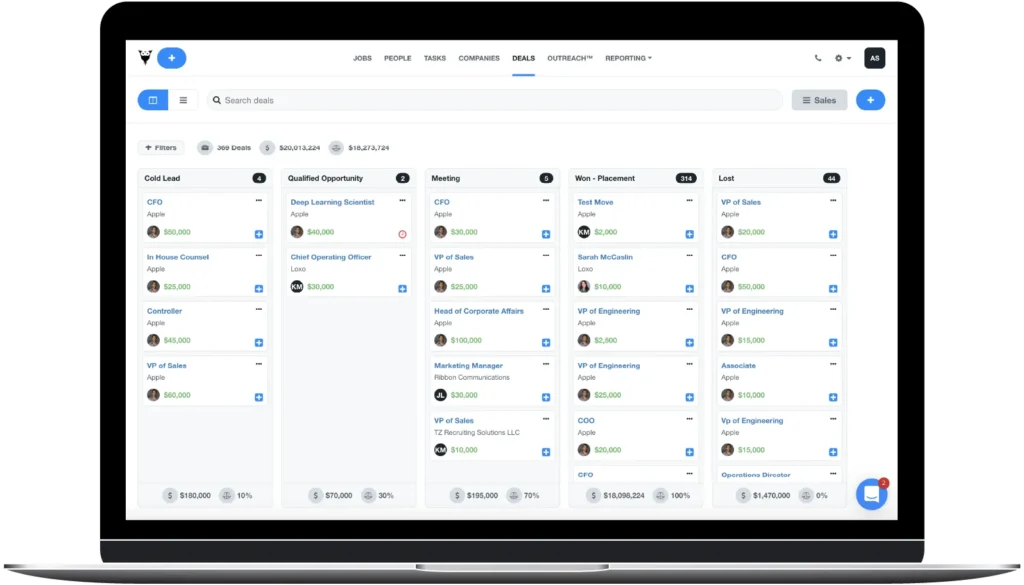
Loxo positions itself as an AI-driven ATS and CRM, with its strongest selling point being sourcing and access to candidate data rather than engagement or workflow.
Features
- Built-in AI capability, including native AI note-taking
- Strong sourcing tools and candidate data access
- Solid integrations and reporting
Is Loxo the right ATS for your agency?
It’s a reasonable fit for sourcing-heavy teams that care most about finding candidates fast and are willing to work around a more limited engagement and workflow layer to get it.
Pros
- Genuinely built-in AI rather than an add-on
- Strong sourcing and candidate database access
- Solid reporting and integrations
Cons
- Limited client and candidate engagement, with no native digital references or interview scheduler for clients
- No calendar integration or team visibility
- Premium tier pricing with lock-in contracts
Atlas
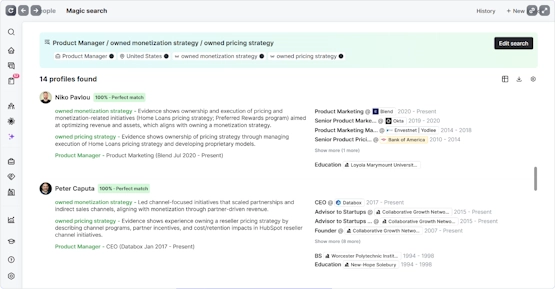
Atlas centres its entire value proposition around AI infrastructure and workflow automation, which makes it a different kind of product to most of the others on this list.
Features
- Built-in AI capability and AI note-taking
- Email integration
- Reporting and analytics
Is Atlas the right ATS for your agency?
It suits teams that want AI-led automation as the main event and are comfortable with a thinner feature set everywhere else, including support, which is AI-led rather than human.
Pros
- Genuinely AI-centric product, not a bolt-on
- Decent reporting and email integration
Cons
- Limited workflow customisation, booking links and integrations
- No calendar integration, team visibility, native digital references, client interview scheduler, resume formatting or candidate engagement features
- Lock-in contracts at around $250 per user, with AI-led rather than human support
Vincere
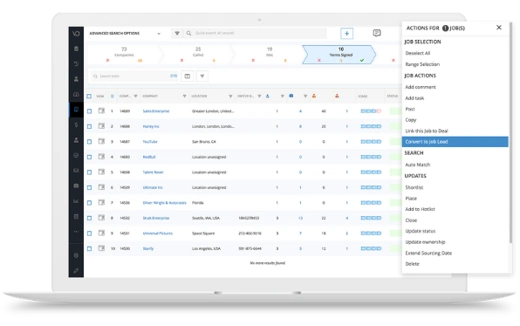
Vincere is a legacy ATS and CRM system that’s been in the market a long time, with a layered set of integrated tools rather than one unified build.
Features
- Native email integration
- Strong third-party integrations
- Tiered pricing from $50 to $500 a month
Is Vincere the right ATS for your agency?
It can work for agencies that are comfortable configuring a system built from several layered tools over the years, and don’t mind that engagement happens through a portal rather than natively.
Pros
- Tiered pricing gives some flexibility on cost
- Strong integrations
- Long track record in the market
Cons
- AI note-taking, resume formatting and reporting are add-ons or portal-dependent rather than core
- No customisable opportunity workflows, calendar integration, team visibility, native digital references, booking links or client interview scheduler
- Limited support, lock-in contracts and an adoption curve the market generally describes as complex and expensive
Zoho Recruit
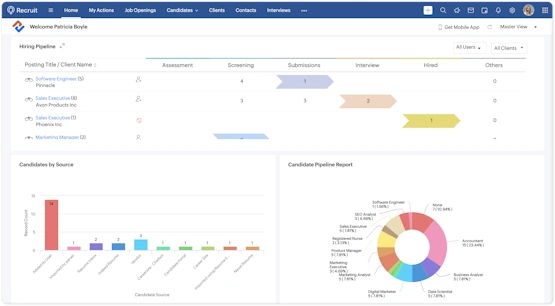
Zoho Recruit is a budget-friendly, configurable ATS that suits simpler or earlier-stage use cases better than it suits a scaling agency.
Features
- Lower starting cost than most of this list
- Native email integration
- Decent third-party integrations
Is Zoho Recruit the right ATS for your agency?
It’s a sensible starting point if budget is the main constraint and your workflow is still simple. It tends to need upgrades or add-ons fairly quickly once an agency starts to grow past that stage.
Pros
- Lower starting price point
- Decent integrations
- Reasonably easy to adopt
Cons
- Limited AI capability and limited customisable workflows
- Limited reporting, with AI note-taking and resume formatting sold as add-ons
- No calendar integration, team visibility, native digital references, booking links, client-facing scheduling or candidate and client engagement tools
- Lock-in contracts and online-only support
Bullhorn
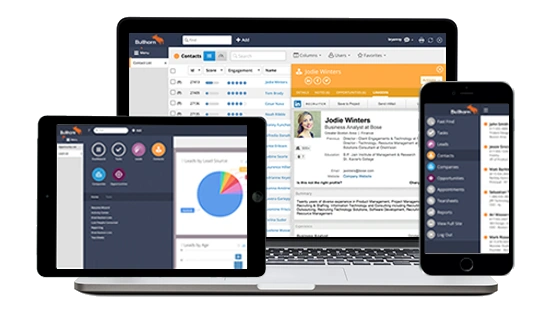
Bullhorn is an established enterprise recruitment system, designed for scale rather than for a lean or fast-moving team.
Features
- Multiple customisable opportunity workflows
- Email and calendar integration
- Strong reporting, analytics and integrations
Is Bullhorn the right ATS for your agency?
It’s built for enterprise-scale agencies that need deep configurability and have the dedicated resourcing to manage significant setup and ongoing configuration. It’s generally overkill for a smaller or mid-sized team.
Pros
- Built for scale and heavy configurability
- Strong reporting and integrations
- Established enterprise track record
Cons
- Complex and expensive to implement, with significant configuration and a longer rollout
- Limited AI capability, with note-taking and resume formatting sold as add-ons
- Online-only support
- No native digital references, booking links, client interview scheduler, live candidate availability updates or client engagement tools
Spott
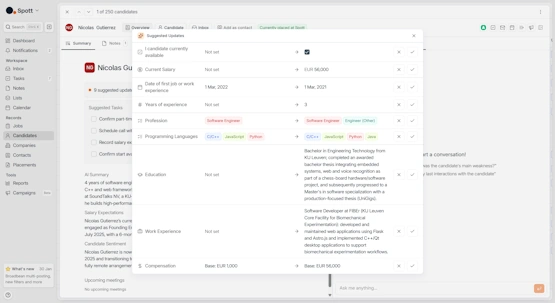
Spott is an AI-native ATS and CRM for recruitment and staffing firms, built from the ground up around AI rather than adding it to an older platform. It’s backed by Y Combinator and a $21M Series A led by Balderton Capital.
Features
- Semantic search and AI matching: ranks candidates using context from job descriptions, CVs and notes, with an explanation for each match
- Auto-updating profiles and enrichment: fills in missing contact details and keeps candidate and client records current without manual upkeep
- Multi-channel outreach and presentations: personalised campaigns, candidate presentations and CV reformatting for clients
- Unibox: a shared inbox combining email, calls and messages, linked to the right candidate or client record, with workflow automations on top
Is Spott the right ATS for your agency?
It suits agencies that want to rebuild their stack around AI from the ground up and are comfortable with a newer vendor. It’s a weaker fit for contract-heavy agencies needing full contractor management, mobile-first teams, or anyone over roughly 1,000 employees, by the vendor’s own description of a poor fit.
Pros
- AI built into the core product rather than added on afterwards
- One platform covering recruiting, CRM, outreach and automation
- Context-based matching that explains its own reasoning, rather than a bare score
Cons
- Contracting features are still being rolled out
- Limited mobile app functionality
- Starting price of $139 per user a month (billed annually, per independent reviews) is higher than most of the names on this list
- Newer vendor, so less of a track record than the established names here
Tracker
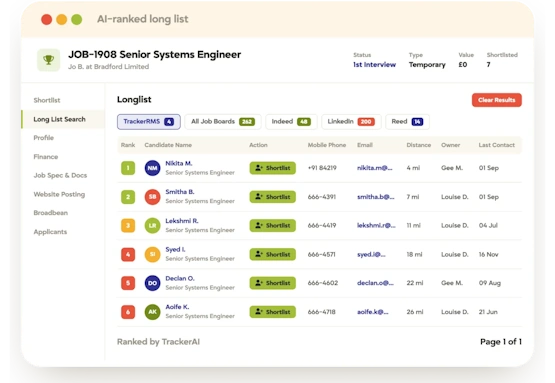
Tracker (TrackerRMS) is a cloud-based ATS, CRM and back-office platform built for staffing and recruitment firms that need recruiting and operations, such as timesheets and invoicing, in one system.
Features
- Resume parsing and job board posting: parses resumes via Daxtra with automatic skill coding, and posts to over 1,000 job boards with de-duplicated results
- TrackerAI: helps write job descriptions, summarise candidates, score matches and flag biased language in postings
- Sentiment-aware outreach: automated email sequences that can stop themselves after a negative reply
- Worker and back-office management: timesheets, expenses, onboarding checklists and eSignature, useful for agencies placing temp or contract workers
Is Tracker the right ATS for your agency?
It’s a solid fit for staffing agencies managing contract or temp workers across multiple locations that want recruiting and back-office functions in one place, and are happy to add modules as they grow. It’s a weaker fit for very small teams without admin capacity, or anyone who wants a modern interface out of the box.
Pros
- Broad all-in-one functionality spanning recruiting and back office
- Strong configurability for complex pipelines
- Responsive onboarding and support, per independent reviews
- Starter plan is month-to-month with no annual contract required
Cons
- Interface described by reviewers as dated or inconsistent
- Several key features, such as automation and back office, are paid add-ons on top of the $80 per user starting price
- Candidates can’t track their own application status through the portal
- Some reviewers report limited API options and occasional stability issues
Seven20
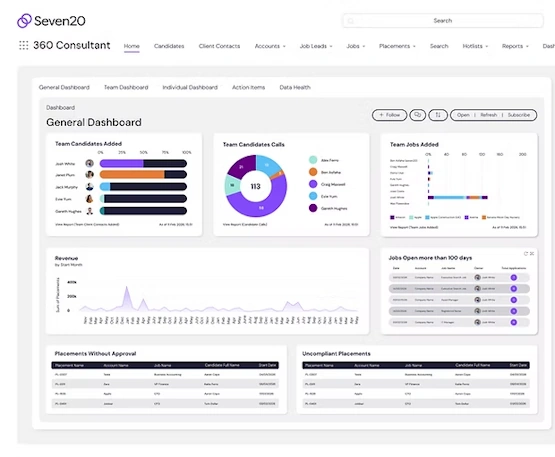
Seven20 is a recruitment CRM and ATS built natively on Salesforce and AWS, positioned around configurability: you choose the modules you need (CRM, ATS, mid and back office, portal, automation, AI) rather than taking a fixed, one-size build.
Features
- AI suite: Notetaker writes call summaries and tasks onto records, Assist proposes field updates from emails and calls, Search lets you query candidates in plain English, and Automation drafts outreach, all gated behind recruiter approval before anything updates
- Branded portal: candidates, clients and suppliers manage profiles, compliance documents and timesheets, with data drawn live from the CRM
- Sequencer: multi-step outreach across email, LinkedIn, SMS and calls
- Salesforce AgentExchange access: taps into the wider Salesforce app ecosystem on top of named integrations like Xero, QuickBooks and Broadbean
Is Seven20 the right ATS for your agency?
It suits agencies with distinctive or changing processes that want Salesforce-grade configurability and have the appetite to manage, or pay for, that complexity. By the vendor’s own messaging, a lighter off-the-shelf tool fits a simple, unchanging perm desk better, which is a fair and honest line worth taking seriously rather than assuming Seven20 is the right fit for every agency.
Pros
- Deep configurability since it’s built natively on Salesforce
- Module-based approach means you pay for what you actually use
- AI changes require recruiter approval before any record updates, which keeps a human in the loop by design
- ISO 27001 certified and GDPR compliant
Cons
- No published pricing, so you’ll need to book a demo before you can compare cost against anything else on this list
- Built on Salesforce, which means taking on Salesforce’s own licensing and complexity alongside Seven20’s
- Implementation runs slower with heavy customisation, by the vendor’s own FAQ
- Some marketing claims, such as “100% 5-star AgentExchange reviews,” are self-reported and not independently verified
JobTetris
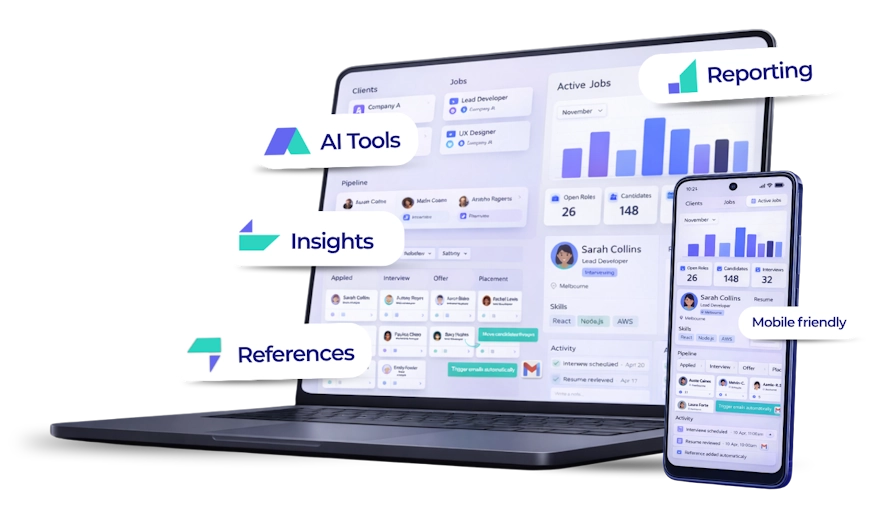
JobTetris is an all-in-one ATS, CRM and engagement platform built for recruitment agencies, from solo recruiters through to large teams, and for companies hiring internally. The positioning is deliberately different from most of the names on this list: instead of a strong ATS with AI and engagement tooling layered on top as separate products, JobTetris was built with all three native from the start.
Features
- AI screening and ranking: scores applicants against the job description with an explanation for every score, rather than a black-box number
- Live candidate and client engagement: chat, information requests and interview invites in a shared view, not a portal either side has to log into separately
- Built-in scheduling and digital references: meeting scheduler, booking links and reference collection included rather than sold as add-ons
- Deal flow and reporting: pipeline by opportunity stage with forecast revenue, alongside time to hire, time to fill and placement reporting
Is JobTetris the right ATS for your agency?
It’s a strong fit if you want AI, engagement and CRM working together out of the box, without assembling three separate tools or paying extra for the features that should have been standard. It’s a less obvious fit if you’re a very large enterprise agency with a dedicated team to manage a heavily customised Salesforce-style build, since that’s a different kind of complexity to the one JobTetris is solving for.
Pros
- AI note-taking, resume formatting and candidate scoring included as standard, not paid add-ons
- Live engagement and scheduling built into the core product
- Month-to-month terms rather than a lock-in contract
- Human support rather than a help centre you log into
Cons
- You won’t have 10 different software vendors inviting you to Christmas parties, just the one
- Recruiters will be even more energetic during the day as they’re not burdened with admin
- Your competition will be sniffing around trying to work out how you’re placing so many candidates!

CRUNCH TIME…
A quick checklist before you choose
- You’ve confirmed whether AI features are included in the base price or billed as an add-on
- You know whether candidates and clients get live engagement or have to log into a separate portal
- You’ve checked the actual contract term, not just the advertised monthly price
- You know whether support is a human or a help centre
- You’ve asked your shortlist for current, written pricing rather than relying on a comparison page that might be out of date
Key takeaways
Across all ten systems here, most are strong at the thing they were originally built around: reporting, sourcing, configurability, back-office operations or low cost. Fewer of them were built with AI, engagement and CRM working together from day one, and the ones that come closest, like Spott, tend to ask you to trade away something else, such as mobile functionality or a lower starting price. That’s the gap JobTetris was built to close, with AI, scheduling, references and engagement included as standard rather than assembled from add-ons after the fact.
Book a demo and see how JobTetris AI is built to pay for itself from day one, not after a year of policy work.