
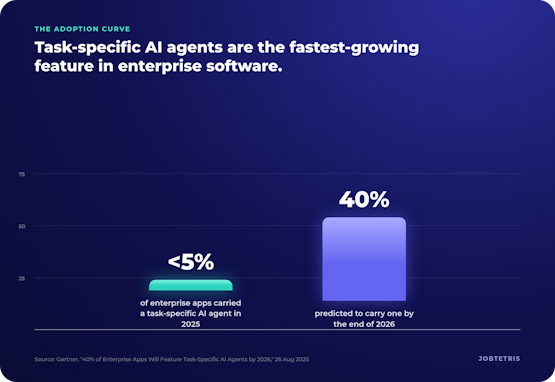
By the end of 2026, Gartner predicts 40% of enterprise applications will carry a task-specific AI agent, up from under 5% in 2025 (Gartner, 26 Aug 2025). More than 40% of those agentic AI projects will be cancelled by the end of 2027. Gartner names the reasons plainly: escalating costs, unclear business value and inadequate risk controls (Gartner, 25 Jun 2025).
That third reason is the one worth sitting with. A cost problem or a value problem gets fixed with a better business case. Inadequate risk controls is a different kind of problem. It means the agent went live before anyone built the guardrails to govern what it can access, what it’s allowed to do on its own, and who checks its work.
Spending more, planning less
The same Gartner research found 38% of companies are already over budget on their AI spend, and 85% plan to spend even more next year. Spend is accelerating well ahead of any plan for what that spend should produce. Only 7% of firms give staff any guidance on how to use the time AI actually frees up.
Gartner’s CV Viverito, a senior director analyst in its HR practice, put the core problem plainly: “Ultimately, organisations will not generate cost savings from AI at this point.” In Viverito’s view, the bigger opportunity isn’t squeezing out savings from existing work. It’s redirecting the capacity AI frees up into new work entirely, rather than assuming hours saved convert automatically into money saved.
A separate 2Q26 Gartner survey of 1,865 employees backs this up with a number: only 21% of the time freed up by AI was redirected into more innovative work. The rest simply gets absorbed back into the day. As Viverito put it, “what organisations are struggling with is how to make that capacity usable.” Freeing up time and using it well turn out to be two very different problems, and most firms have only solved the first one.
Underneath both numbers sits a more basic issue. A July 2026 Gartner survey of 297 CHROs found 78% of HR leaders aren’t aligned internally on where AI actually creates value. Spend without a shared answer to “value from what, exactly” is spend without a measurable return, no matter how the budget gets justified at the top.

CHANGE IS AFOOT
Regulators are closing that gap, on a longer runway than planned
The EU AI Act treats AI used to evaluate job applications, filter candidates, or influence pay, promotion or dismissal decisions as high-risk, the same Annex III category as AI used in critical infrastructure. High-risk systems need effective human oversight under Article 14, able to detect and correct errors including discriminatory patterns, not just a policy document saying the system is safe. Deployers have to keep the logs these systems generate for at least six months, and run a mandatory risk assessment before relying on one (ArtificialIntelligenceAct.eu).
The compliance deadline for this category has just moved, from 2 August 2026 to 2 December 2027, after the EU Council gave its final approval to the delay on 29 June 2026 (Ogletree Deakins, 16 Jun 2026). That sounds like relief. It isn’t much. The obligations haven’t changed, only the clock has moved, and a hiring tool built without oversight, logging or a risk assessment in mind doesn’t become compliant just because the deadline is further away.
The people on the receiving end have already noticed
Guardrails aren’t only a regulatory problem. They’re a trust problem, and candidates are ahead of the compliance timeline on this one.
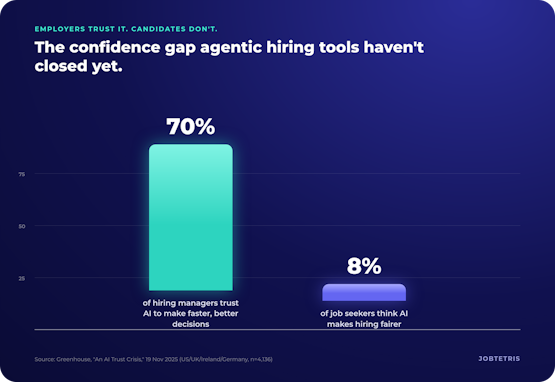
Greenhouse’s 2025 AI in Hiring Report, covering the US, UK, Ireland and Germany, found 70% of hiring managers trust AI to make faster, better hiring decisions. Only 8% of job seekers think AI makes hiring fairer (Greenhouse, 19 Nov 2025). Among US job seekers specifically, 46% say their trust in hiring has fallen over the past year, 42% of them blame AI directly, and that number climbs to 62% among Gen Z candidates applying for entry-level roles. Even on the employer side the confidence isn’t as solid as the 70% headline suggests: a quarter of recruiters in the same survey say they aren’t confident in their own AI systems, and only 21% are very confident those systems aren’t rejecting qualified candidates.
Gartner’s own candidate research, a survey of 2,918 job candidates, found much the same gap from a different angle: 52% of candidates already believe AI is screening their application, but only 26% trust it to evaluate them fairly (Gartner, 31 Jul 2025). Candidates have correctly worked out that AI is involved. Nobody has shown them the guardrails that would earn their trust back.

WHAT ACTUALLY WORKS
The three guardrails that actually hold up
Strip away the hype, the regulation and the trust data, and they’re all pointing at the same three things. An agentic AI deployment that lasts, rather than one that gets quietly shelved, distrusted or cancelled, has explainability, so a decision can be stated in plain language rather than defended after the fact. It has logging, so a decision can be audited by someone who wasn’t in the room when it was made. And it has scoped access, a hard limit on what the agent can read or act on, rather than a general licence to see everything and hope it behaves. Miss any one of these and you’re looking at exactly the “inadequate risk controls” problem Gartner names as a cancellation driver, and exactly the gap the EU AI Act is now writing into law.
Where JobTetris already builds the guardrails in
This is where JobTetris’s AI was built differently from the start, rather than retrofitted once the regulation or the cancellation data arrived.
AI Restrictions, now live in production, let an admin set exactly what the AI can read on a candidate’s notes and documents, by data source and document type, with every change audited. That’s scoped access as a real settings feature, not a policy nobody follows. Every AI score on a candidate ships with a plain-English reason alongside it, and Dual Rating keeps that score next to the recruiter’s own judgement rather than replacing it, so there’s a human checkpoint and an explainable answer any time someone asks why a candidate was ranked the way they were. The Own AI connection, which lets an agency link its own Claude account, is read-only, off by default until an admin switches it on, and every lookup through it is logged. Smart Notes and the CRM Assistant follow the same pattern elsewhere in the product: suggestions and actions, never silent changes, with a confirm step before anything actually happens.
None of that makes JobTetris exempt from the regulation, and it doesn’t make an agency immune to the broader slowdown Gartner is describing. It does mean the three guardrails that separate a surviving agentic deployment from a cancelled one, scoped access, human oversight and logging, are already built into the product, in the same shape the EU AI Act is now asking every employer to have, rather than left as a project an agency has to build on its own before it can trust what it bought.
A quick audit: would your AI survive a risk review?
Run through this before rolling out, or expanding, any agentic AI tool in your hiring process.
- You can show, in plain language, why any specific candidate was scored or ranked the way they were
- You can name the hard limit on what each AI feature can read or act on, not just a vendor’s assurance that it’s “safe”
- Every action an AI tool takes, not just every suggestion, is logged somewhere you could actually produce if asked
- A human has to confirm before anything the AI touches becomes irreversible
- You know whether what you bought is genuinely agentic, or a workflow with an agentic label attached to sell it
Key takeaways
Agentic AI adoption keeps climbing, and Gartner’s own forecast says a large share of it gets cancelled within two years, mostly for lack of risk controls rather than lack of capability. Regulators are now writing those same controls into law, on a timeline that just got longer but didn’t get lighter. Candidates have already noticed the gap between how confident employers are and how fair the process actually feels. The agencies still running agentic tools in 2028 will be the ones that treated scoped access, human oversight and logging as guardrails from day one, not paperwork to add once someone asks.
See how JobTetris AI builds those guardrails in from day one…