
Most boards expect AI to pay for itself. Most won’t get what they’re expecting.
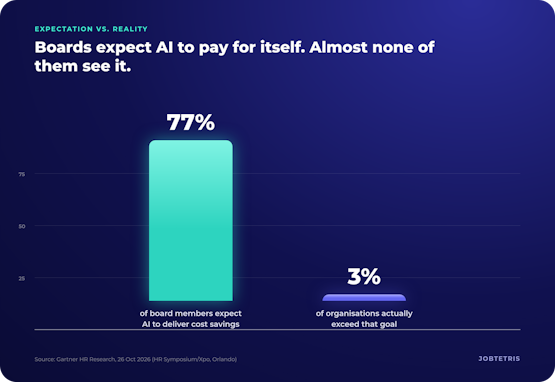
Gartner’s HR research, presented at its HR Symposium in Orlando on 26 October 2026, found that 77% of board members expect AI to deliver productivity and cost savings. Only 3% of organisations actually exceed their cost-savings goals through productivity, and 97% can’t reach those goals through productivity alone (Gartner, 26 Oct 2026). That gap isn’t a sign AI doesn’t work. It’s a sign most organisations haven’t planned for what happens after it starts working.
For a small or mid-sized agency watching bigger competitors talk up their AI roadmaps, that’s worth sitting with before writing the next cheque. The organisations in Gartner’s research aren’t failing to adopt AI. They’re adopting it and still not seeing the return they expected, which is a different and more useful problem to understand.

EXCITEMENT OVER ALIGNMENT
Spending more, planning less
The same Gartner research found 38% of companies are already over budget on their AI spend, and 85% plan to spend even more next year. Spend is accelerating well ahead of any plan for what that spend should produce. Only 7% of firms give staff any guidance on how to use the time AI actually frees up.
Gartner’s CV Viverito, a senior director analyst in its HR practice, put the core problem plainly: “Ultimately, organisations will not generate cost savings from AI at this point.” In Viverito’s view, the bigger opportunity isn’t squeezing out savings from existing work. It’s redirecting the capacity AI frees up into new work entirely, rather than assuming hours saved convert automatically into money saved.
A separate 2Q26 Gartner survey of 1,865 employees backs this up with a number: only 21% of the time freed up by AI was redirected into more innovative work. The rest simply gets absorbed back into the day. As Viverito put it, “what organisations are struggling with is how to make that capacity usable.” Freeing up time and using it well turn out to be two very different problems, and most firms have only solved the first one.
Underneath both numbers sits a more basic issue. A July 2026 Gartner survey of 297 CHROs found 78% of HR leaders aren’t aligned internally on where AI actually creates value. Spend without a shared answer to “value from what, exactly” is spend without a measurable return, no matter how the budget gets justified at the top.
Most teams can’t tell AI from automation
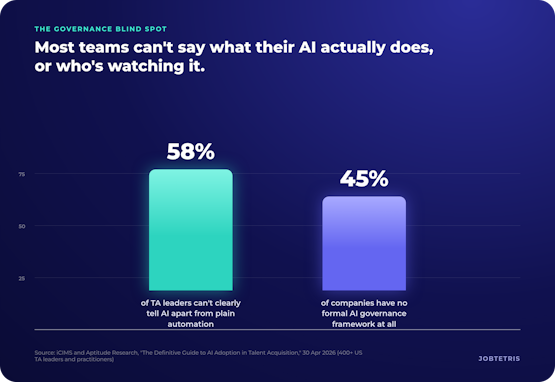
The confusion runs deeper than budgeting. In an April 2026 survey of more than 400 US talent acquisition leaders and practitioners, iCIMS and Aptitude Research found 58% of TA leaders are unclear on the actual difference between AI and plain automation, and 45% of companies have no formal AI governance framework in place at all (iCIMS and Aptitude Research, 30 Apr 2026).
That’s the real reason return on AI spend is so hard to demonstrate. If a team can’t say what’s genuinely AI-driven versus a rule-based shortcut they already had before any of this started, they can’t measure what the AI actually added. And if there’s no governance framework, nobody is responsible for answering that question either way, so it never gets asked.

TIME TO PROPERLY APPLY WHAT YOU HAVE
What this looks like inside a recruitment agency, not just a boardroom
Gartner’s numbers come from enterprise HR functions with budgets most agencies don’t have. The underlying pattern still applies at agency scale, often more sharply, because there’s less slack to absorb a tool that doesn’t pay for itself.
A consultant using three different point tools that each claim to be “AI powered” has no real way to know which of them is actually doing anything a saved search or a template couldn’t already do. A principal signing off on a new AI add-on each quarter has no tracker showing whether last quarter’s purchase changed a single outcome. And when nobody in the business owns the question of what the AI can access or why, that’s not a policy gap waiting to be filled later. It’s the same 45%-with-no-governance-framework problem, just without the title “governance framework” attached to it.
The fix isn’t more AI, it’s AI you can actually use
None of this means AI doesn’t belong in recruitment software. It means the AI that earns its spend back is the kind that’s scoped and usable from day one, not a second project to govern before anyone benefits from it.
That’s the design behind JobTetris AI. AI Restrictions, now live in production, let an admin set exactly what the AI can read on a candidate’s notes and documents, by data source and document type, so the “where’s the governance” question has an actual answer built into the settings instead of sitting as an open policy gap. Dual Rating puts an AI score beside the recruiter’s own on every applicant, without ever overwriting it, so there’s no confusion about which number to trust or who’s accountable for the final call. Smart Notes reads notes, emails and call transcriptions where activated, and suggests profile updates and follow-up tasks, but a recruiter accepts or rejects every one, so using the time it saves doesn’t require retraining anyone on a new process. The newer candidate-job matching works both ways: a candidate’s own profile shows which live jobs they suit, and a job shows which candidates suit it, cutting out a manual cross-reference step most agencies are still doing by hand. The CRM Assistant answers plain-English questions and can create tasks or move pipeline stages, but only after you confirm, which is exactly the kind of guidance on using freed-up time that only 7% of firms currently give their staff.
None of that is marketing gloss over a governance gap. It’s the governance built into the workflow itself, so the agency doesn’t have to build a separate project around it before the AI starts paying for itself.
A quick audit: is your AI spend actually working?
Run through this with your leadership team. If you answer yes to three or more, your AI spend is likely following the exact pattern Gartner describes, cost without a clear return.
- Nobody on your team could confidently say which parts of your workflow are genuinely AI-driven versus simple automation
- There’s no written policy on what your AI tools can and can’t access
- Time saved by AI hasn’t translated into any new activity, it’s just absorbed into the day
- You’re spending more on AI tools this year than last, without a clear answer for what that spend bought
- Recruiters don’t know whether to trust an AI score over their own judgement, or the other way round
- Nobody owns AI governance as an actual responsibility, it’s assumed to be someone else’s job
Key takeaways
Most organisations won’t see a return on AI spend this year, and Gartner’s own research says so plainly. The cause isn’t the technology. It’s spending on AI without a plan for where the value comes from, without the ability to tell AI apart from automation, and without anyone owning governance. Fixing that doesn’t mean spending less. It means choosing AI that’s already scoped, already explains itself and already keeps a human decision in the loop, so the return doesn’t depend on a governance project you haven’t built yet.
Book a demo and see how JobTetris AI is built to pay for itself from day one, not after a year of policy work.