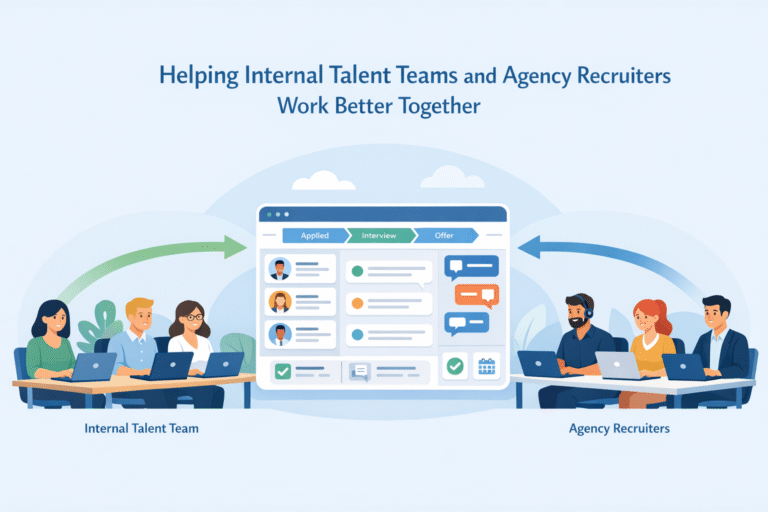
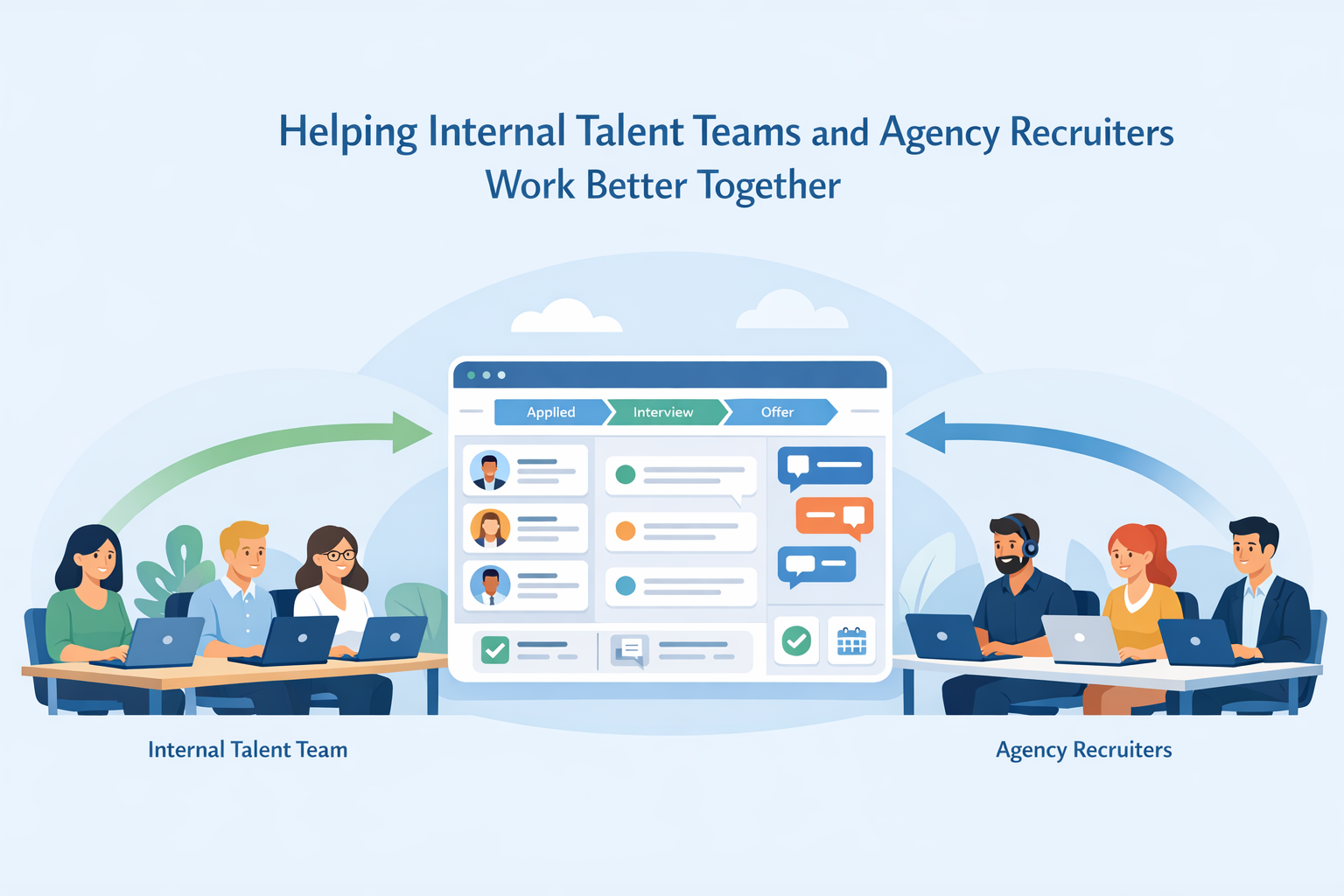
Helping Internal Talent Teams and Agency Recruiters Work Better Together
Recruitment works best when the right people are aligned around a shared outcome: a successful hire.
But in reality, collaboration between internal talent teams and agency recruiters often falls short. Not because of poor intentions or lack of effort, but because the systems and processes meant to support collaboration were never designed for it.
When Recruitment Becomes Sequential Instead of Collaborative
A familiar pattern plays out across many organisations.
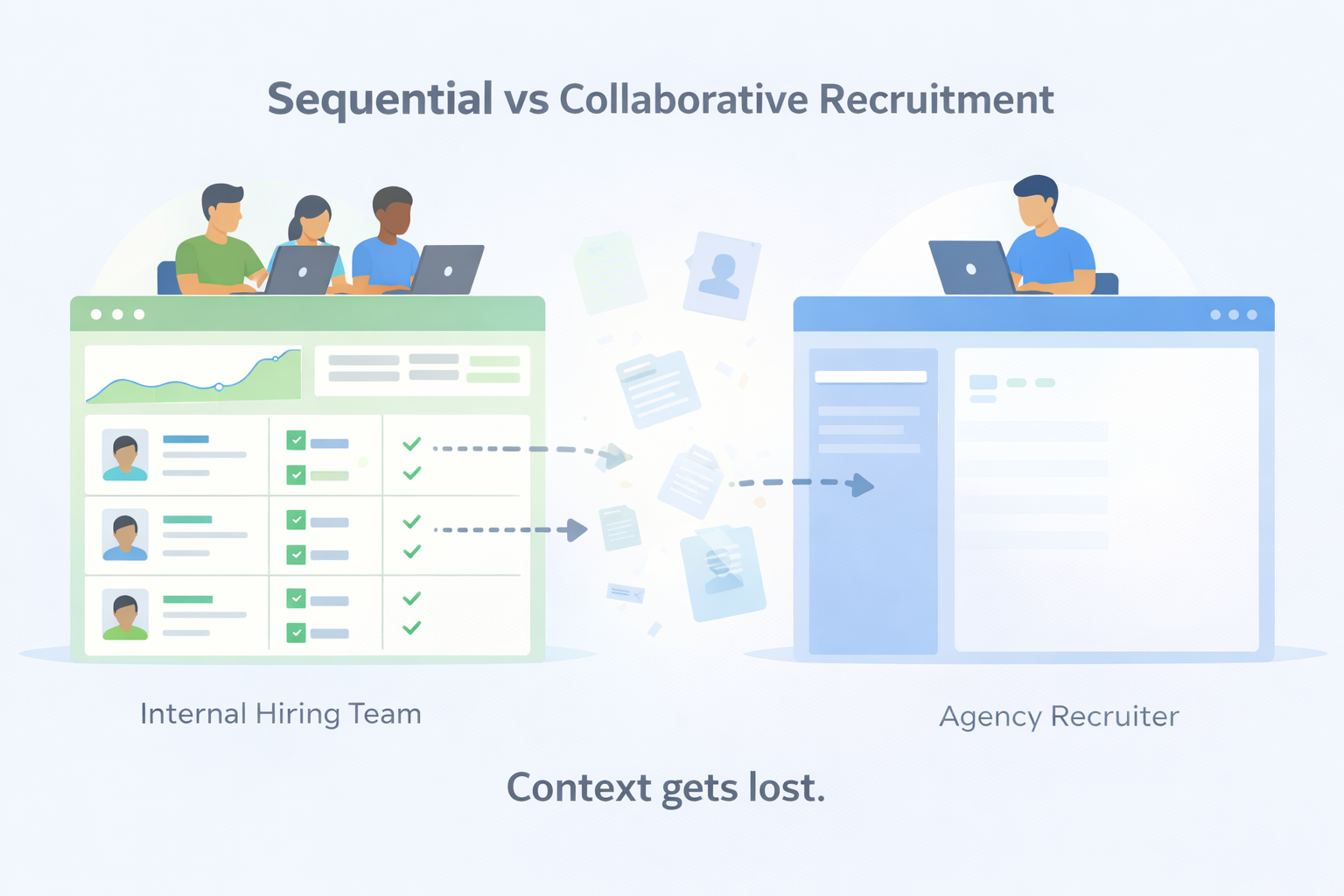
An internal talent team goes to market first. Applications are received, reviewed, and assessed. When the right candidate does not emerge, an agency recruiter is engaged to assist.
At that point, recruitment often becomes sequential rather than collaborative.
The role moves from one group to another, but the context does not always follow. Candidates already reviewed, conversations already had, and decisions already made are often invisible to the next party involved.
This is rarely intentional. Internal teams are balancing privacy obligations, process constraints, and workload. Agencies step in focused on adding value quickly, often without full visibility of what has already occurred.
The result is not failure.
It is inefficiency.

The Impact of Limited Visibility
Modern candidates move fast. According to linkedin talent solutions,
more than 70 percent of job seekers apply for multiple roles at the same time.
seek news reports similar patterns in Australia, particularly in competitive or skills-short markets.
This means overlap is inevitable.
Without shared visibility, candidates often reappear through different channels for the same role. Recruiters spend time re-screening familiar profiles. Internal teams receive repeat submissions. Candidates are re-engaged, sometimes with renewed optimism, only to reach the same outcome.
From an experience perspective, this can feel disjointed.
From an operational perspective, it creates rework on all sides.
Research from Deloitte suggests recruiters spend up to 30 percent of their time on administrative tasks, much of it driven by duplication and disconnected systems. When agencies and internal teams work on the same role without shared signals, that inefficiency compounds.
Collaboration Does Not Mean Sharing Data
One of the biggest misconceptions in recruitment collaboration is that working together requires sharing candidate resumes, notes, or personal information.
Privacy concerns are valid and non-negotiable. Frameworks such as the Australian Privacy Principles and GDPR exist for good reason. But collaboration does not need to come at the expense of compliance.
What teams often need is awareness, not access:
Has this candidate already applied for this role?
Has this profile already been reviewed?
Has this conversation already happened?
These signals can exist without exposing personal data. Yet most recruitment systems are simply not built to support this level of coordination between internal and external teams.
The Limits of Traditional Recruitment Technology
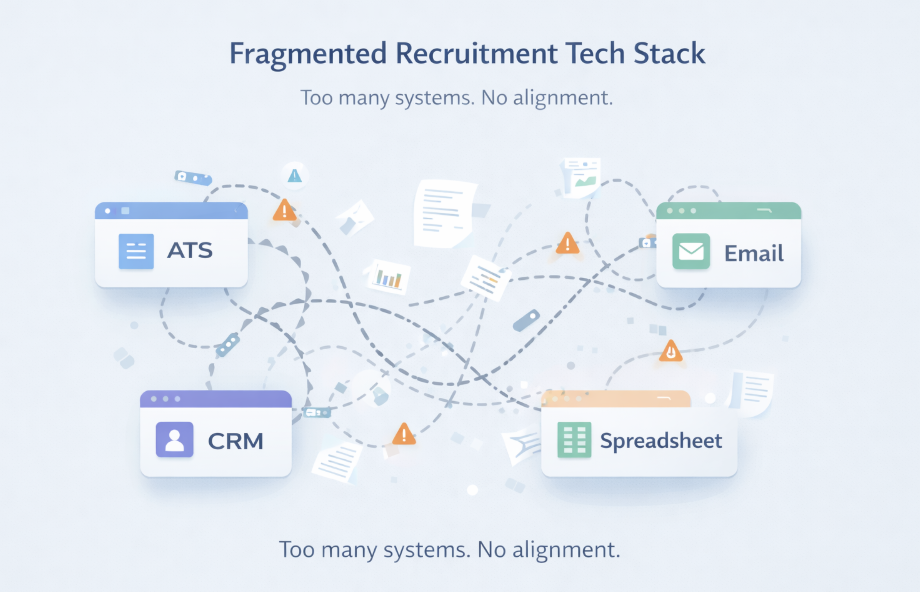
Internal talent teams typically operate within an ATS optimised for direct hiring. Agencies work within CRMs designed for sourcing, relationship management, and placements.
Each system works well in isolation.
They rarely talk to each other.
Context is lost between platforms. Communication shifts to email, spreadsheets, or informal updates. Visibility depends on memory rather than systems.
This fragmentation makes collaboration harder than it needs to be, even when both sides are aligned and willing.
A Different Way to Think About Working Together
Better collaboration starts with a mindset shift.
Internal talent teams and agency recruiters are not competing for ownership.
They are contributing different strengths to the same outcome.
Internal teams bring:
• Deep organisational context
• Employer branding
• Long-term workforce planning
Agencies bring:
• Market reach
• Sourcing capability
• Speed to execution
The goal is not control.
It is coordination.

Where Jobtetris Fit
This is the gap JobTetris was built to address.
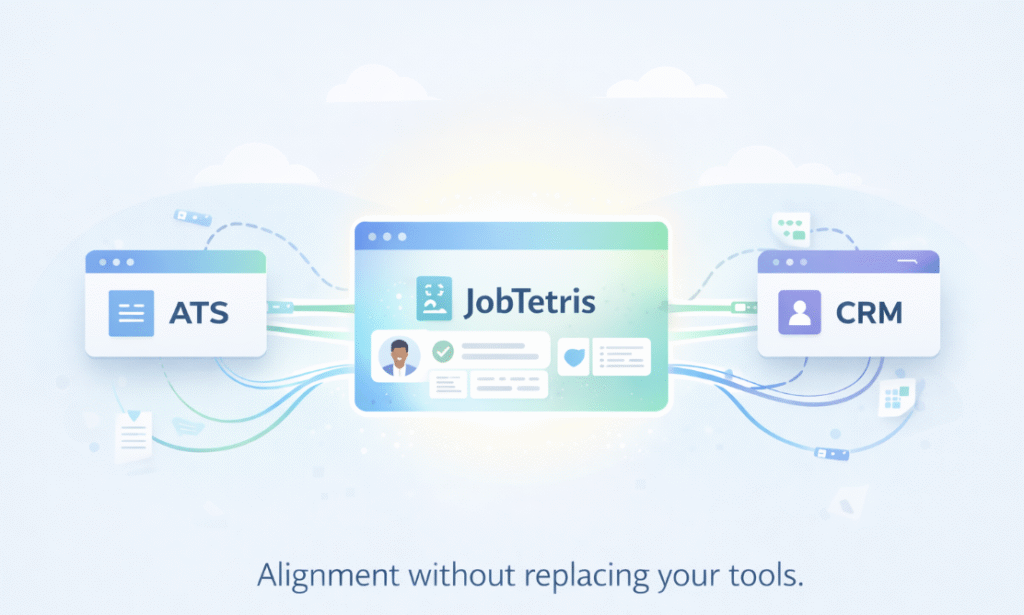
Rather than forcing data sharing between internal teams and agencies, JobTetris provides visibility without exposure.
Both sides can see when a candidate has already been engaged or reviewed for the same role, without sharing resumes, contact details, or assessment notes.
The platform does not replace existing ATS or CRM systems.
It sits across them, helping teams align rather than operate in silos.
When overlap is visible early:
• Agencies redirect effort to genuinely new talent
• Internal teams avoid reprocessing candidates
• Candidates receive clearer, more consistent communication
• Hiring decisions move faster, with less friction
From Automation to Alignment
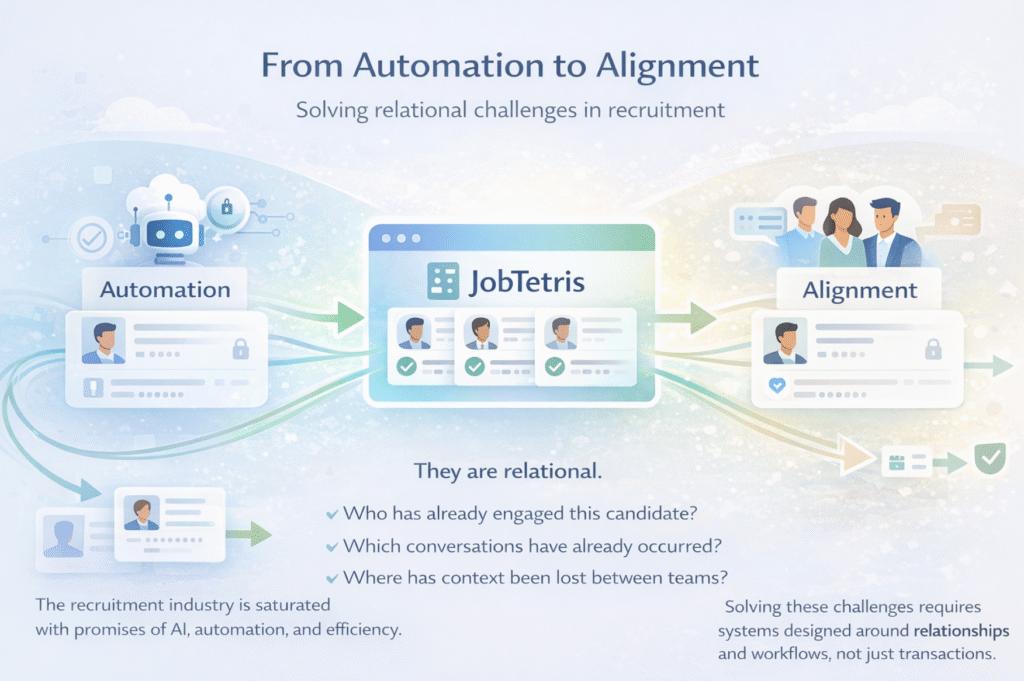
The recruitment industry is saturated with promises of AI, automation, and efficiency.
While these tools have a role to play, many of the most persistent challenges are not technical.
They are relational.
Who has already engaged this candidate?
Which conversations have already occurred?
Where has context been lost between teams?
Solving these challenges requires systems designed around relationships and workflows, not just transactions.
A More Sustainable Model for Hiring
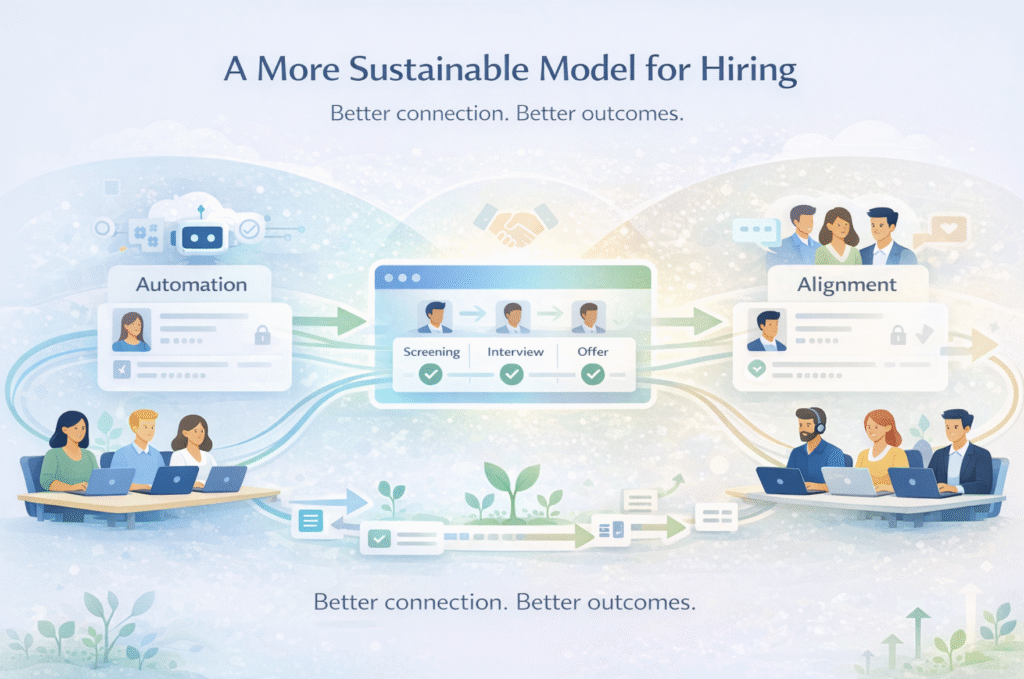
As candidate behaviour continues to evolve and hiring pressure increases, collaboration will become a competitive advantage rather than a nice-to-have.
Organisations that succeed will be those that:
• Acknowledge how recruitment actually happens in practice
• Design processes that reflect that reality
• Enable internal and external teams to work together effectively
Recruitment does not need more tools working in isolation.
It needs better connection between the people already involved.
Not artificial intelligence.
Relationship intelligence.